This article was first published in
Our understanding of the world, beyond the most direct elements in our personal life, is always mediated. In today’s information landscape, whether your knowledge is mediated by the mainstream ‘quality’ press or social media, you would be forgiven for thinking that huge ‘crowds’ of ‘protestors’ gathered across towns and cities in the UK to express their ‘legitimate’ ‘grievances’ and ‘concerns’ over immigration and asylum seekers. You would be forgiven to think asylum seekers arriving by boats are the biggest crisis in ‘lawless’ Britain and that ‘mass deportations’ are the only solution, only one to be debated in terms of practicalities rather than politics.
In fact, unless you were on the ground, know someone who was or are connected in one way or another to alternative voices, you could easily believe that this is what the British ‘people’ and, even more so, the ‘left behind’ want. This would therefore make asking whether gunboats should be deployed to stop those searching for asylum not appear as the fascist and authoritarian measures they are, but as simply responding to democratic demands. You may disagree but, after all, this might be what democracy is all about.
While I could turn to the right-wing gutter press to find excruciating examples of misinformation, it would do little for us in understanding how these narratives become accepted more widely in society. This is why I find looking at the centre left, ‘quality’ press more illuminating. And here, The Guardian’s coverage of the weekend’s ‘protests’ is telling. The impression from the headline is that demonstrations were widespread, strong and opposed to the police. Counter-protesters appear in the subheadline, with a claim that the police separated ‘rival groups’.
Numbers in the article are scarce and it is hard to get a clear picture as to how many people gathered, and whose side they were on. There is also very little analysis of the politics behind these protests or who is organising them. Instead, their own line is repeated, telling us that the protests started taking place ‘after an asylum seeker was charged with trying to kiss a 14-year-old girl, which he denies’.
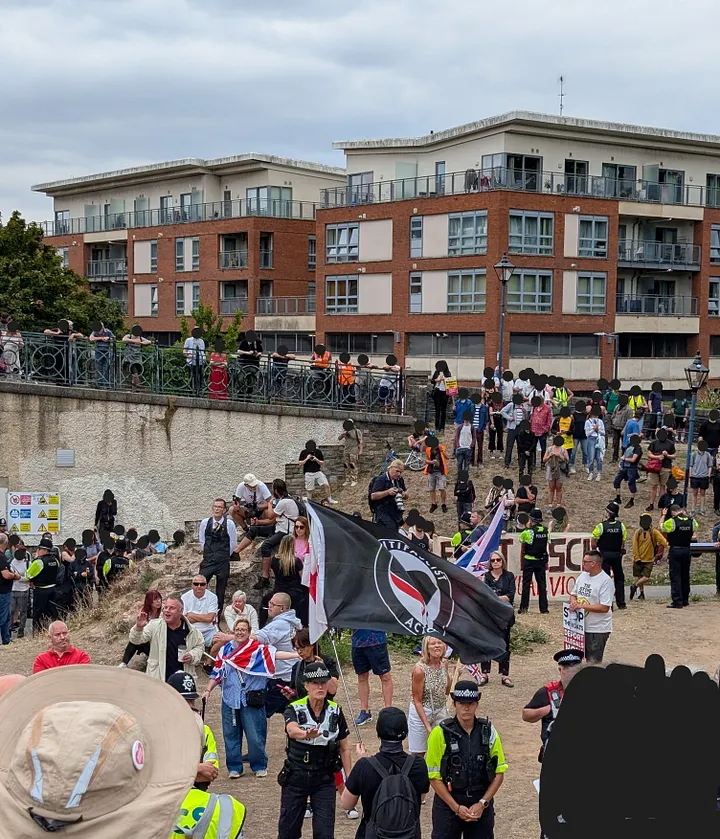
As it happens, I was in Bristol on Saturday. Compared to what I witnessed firsthand, the Guardian’s coverage is shockingly inaccurate, but sadly unsurprising. ‘Protestors’ were chanting racist slogans and were clearly far right. They numbered at most 50 and were outnumbered at least 10 to 1. The police did not separate rival group but protected this tiny minority and allowed them to block the city for hours and make their way towards their target, while their aim was to go and threaten already deeply traumatised asylum seekers. In the end, the dedication of the diverse crowd of counter-protesters prevented the far right from reaching the hotel.
Yet, these people, who come from all walks of life and are genuinely organised through grassroots groups, are not recognised as ‘the people’. While many come from marginalised communities themselves and are clearly working-class, they are not considered as part of the ‘left behind’. Their voices are not deserving of being heard.
Instead, if we are to believe mainstream media coverage and politicians, it is the far right that expresses the only democratic resentment from below. Yet for all the talks of crowds marching across the UK, based on the estimates of those who actually bothered looking, there were between 500 and 1000 far-right protesters across the UK despite the incredible amount of free publicity they received and the blessing of the government and much of the media. Against all proof to the contrary, populist hype has made us believe that the far right speaks for the people or even the working class, while its politics are always innately elitist, something exemplified by their leadership. It has also been shown clearly that the organisation of the protests has been a top-down affair, carefully orchestrated rather than organically rising from the streets. Similarly, contrary to caricatural understandings of what the working class means, it is also clear that the rise of the far right find its roots in wealthier sections of society. Much like J.D. Vance is not the voice of the left behind, neither is Nigel Farage — that much should be obvious and yet.
Beyond the appalling coverage of this particular event, what we must ask ourselves is why there is such a discrepancy about who deserves to be heard. Think of the demonstrations against austerity, against the Iraq War, for trans rights, as part of the Black Lives Matter movement, to raise the alarm about the climate crisis, and of course against the genocide in Gaza. Then compare it to the coverage of a few thousand far-right protestors whose aims are to bring about a fascist order. Why are some painted as having ‘legitimate concerns’ emanating from the ‘left behind’, despite all evidence to the contrary, while others are simply noise, the voice of naïve radicals or even terrorists?
This is not a trivial exercise either. This is how mediated meaning is created and this is how most of us make sense of the world. The vast majority of people will not have been on the ground or know people who were, and will rely on the media to tell them what happened. They may mean well and be against the far right, but it is understandable in the current public climate that they may feel the far right is much bigger than it really is, that asylum seekers (or trans people, or Muslim communities, or the left) are a threat to those at the bottom. They may believe that Reform is indeed a popular alternative, when it is simply less popular than the pale copies both the Conservative party and Labour have become. This is how the far right is hyped and normalised.
In my previous research, I have explored how our knowledge of the world is constructed, and in particular how the ‘immigration issue’ was imposed on us from the top down. While many (although not most) respondents to opinion polls do place immigration as a major concerns when they think of their country, few of the same respondents believe it is an issue when they think of their own day-to-day lives. Instead, their concerns are far more mundane, but also amenable to left-wing politics (inflation, health, pensions, unemployment, education etc). Yet we are told our elite, whether in the media or politics, have no choice but to abide by the demands of ‘the people’, crackdown on those most marginalised and vulnerable and provide nothing to actually address the many crises we are facing.
Crucially, there is an element of self-fulfilling prophecy as many people start accepting that immigration, trans rights, disability benefits etc are indeed a major concern for ‘the people’, if not for them. As such, they stop protesting or asking for better as they are made to feel their views are marginal. It also convinces some that the far right is indeed an alternative to the status quo and one that is painted as more reasonable than the left since this is also where the mainstream parties take their cues.
For our elite, the far right acts as a distraction away from the inability of our current system to bring justice to the many, something which would require radical reform (not Reform UK who merely want more of the same exploitation and misery with more authoritarianism). Instead, our elite choose to fuel the far right, regardless of the cost to those at the sharp end of its politics and more widely to democracy. If we are to understand why fascists feel comfortable openly expressing their authoritarian and racist views, we must think about what has changed from the time when they were scared to do so. How is Nigel Farage able to promise ‘mass deportations’ without anyone in mainstream media and politics batting an eye-lid when this would have been considered beyond the pale only a few years ago? To understand this, and considering the far right support remains marginal and is directly fuelled by this process of mainstreaming, we must look at the role of those with a privileged access to public discourse.
As MPs start receiving threats from emboldened fascists and some media commentators start to raise alarm about the state of public discourse, one can hope they start seriously considering their role in our current predicament. It is clear than when it was only marginalised communities at the sharp end of far-right violence, their solidarity and understanding was scarce.
For the rest of us therefore, and while there can be no complacency in countering fascists on the streets, concerns about the far right should also be concerns about mainstream politicians and media, as they have played a key part in making the far right the threat it is today, despite pretending to be bulwarks. We will not defeat the far right without changing a system that uses it as a distraction and without constructing a public arena where our choices are not limited to the bad and the worse.