This article was first published in the RPRN’s Red Lines
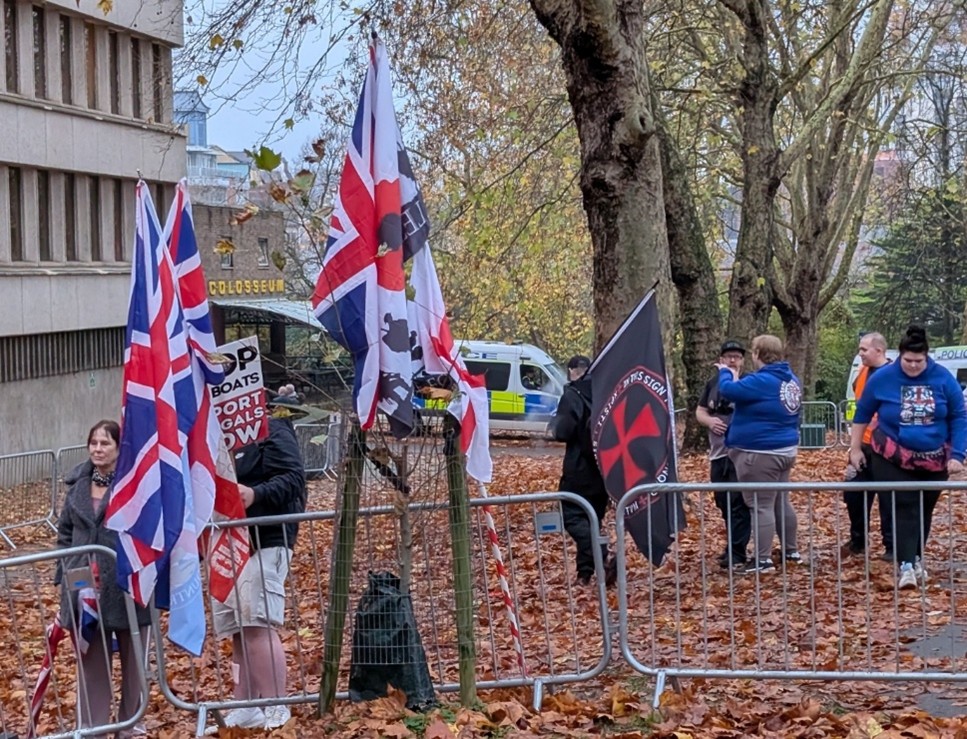
Another Saturday, another extreme-right demonstration in Bristol. A coalition led by the British Patriots and UKIP, and attended by Britain First and the EDL, set its sights on a hotel housing refugees and asylum seekers. Between 75 and 100 turned up in an attempt to terrify people already deeply traumatised. While they have claimed in recent months and years that their concerns are about violence against women and girls, it is clear from these demonstrations that it is racism that drives them. Many children could be seen peering through the hotel windows throughout the protest, and all the extreme right had to offer them were offensive gestures and threats.

Image copyright: Jamie Bellinger
Fortunately, hundreds of counter-protestors turned up once more and drowned out whatever noise the extreme right was trying to make. It was heartening seeing the kids at the windows waving as the crowd chanted ‘refugees are welcome here’ and ‘there are many many more of us than you’. For now, Bristol remains antifascist.[1]
Yet there can be no complacency as it is clear that fascists are becoming increasingly emboldened. While numbers remain very small, they are growing, demonstrating that more feel less ashamed to be seen publicly embracing extreme right politics.
While it is absolutely essential that communities keep turning up to stand against the far right, regardless of their targets, we cannot lose sight of why this emboldening is taking place. Nor can we limit ourselves to pointing to the far- and extreme-right elite. For one, their popularity is constructed through the support they get from billionaires and their media empires. Tommy Robinson’s sycophantic dialogue with Elon Musk at the Unite the Kingdom rally in September should make it clear that he is not a rebel but on the side of extreme wealth and power, and that his followers are their useful idiots.
Yet even this would not be enough to put fascism into power. Any serious study of history will tell us that fascism has never needed to be popular to get to power. What it has always needed on the other hand is the complicity of the mainstream elite of the time. Whether in Italy or Germany, it was the fear of a radical alternative from the left that opened the door to the fascists seizing power. While history never repeats itself in exactly the same way, lessons have clearly not been learnt as similarities between our current predicament and the 1930s abound.
This could not be clearer than in the deeply cynical use of far- and extreme-right moral panics by the current Labour government. I am not interested in whether Starmer and his colleagues believe in the politics they are putting forward, but rather in the impact this is having on our democracy. Since its election, the Labour government has been consistent in shining the spotlight on marginalised communities to distract from their unwillingness to tackle the many crises facing the UK. Whether it has been attacks on trans people, refugees, asylum seekers or migrants, disabled people or those needing welfare support (all intricately linked to class), the government has taken a deeply reactionary approach politically and discursively. Nothing could exemplify this better than Home secretary Shabana Mahmood declaring that ‘illegal immigration is tearing Britain apart’ at a time of rising racist violence and as the government offers nothing to address the many crises facing people in the UK. The proposal to implement cruel policies such as longer wait to gain indefinite leave to remain and the possibility of removal should the country of origin be deemed safe again will only add further precarity and hardship to deeply traumatised people.
This is simply unforgivable as research has shown for many years now that, despite claims from the government that ‘tough’ decisions are taken to fend off the far right, it never helps. Quite the contrary in fact. Not only is Labour haemorrhaging support, but far-right politics and their bad faith actors become legitimised and mainstreamed in the process.
The failure to stand up not just for what is right, but for the most basic democratic standards, is equally shared by the media elite. While it is not surprising to see the increasingly radicalised right-wing press cheer on the rise of fascism as it suits its owners’ interests and politics, the failure of the liberal media to uphold the values it claims to work by has been truly spectacular. Countless platforms have been given to bad faith reactionary actors who mainstream ideas which are a direct threat to communities and democracy more widely, as if they were a legitimate part of the debate. It may seem silly but maybe we do not need to ask someone accused of spreading racist discourse what their definition of racism is – or at least we do not have to publish it as if it were a legitimate intervention or providing ‘balance’.
Nor should the media apologise for calling a spade a spade, something the BBC has failed to do time and again when it comes to reactionary politics, setting the tone for other media too cowardly to even check with their legal teams whether this is needed. As if to prove a point, on the weekend, the BBC changed what was a positive headline – ‘anti-migrant protest dwarfed by counter demonstration in Bristol’ – to framing counter-protestors as the issue (‘Arrests after officers assaulted at protest’). The original was still far away from what is needed, as ‘anti-migrant’ is a clear euphemism to describe ‘protestors’ waving flags with the Iron Cross… This is not just the BBC obviously; I’ve previously written about the appalling Guardian coverage of a previous protest.
On this, academics have also played their part by euphemising far-right and racist politics as ‘populism’ for too long or pretending that good, ‘objective’ research means that we cannot weigh in on public debates, as if we can study society without it impacting us or us impacting it.
This leaves us in an incredibly precarious position where the threat does not simply come from a marginalised far right as it seemed to even a decade ago, but where it is increasingly clear that the mainstream elite and institutions will not be a bulwark. If we are to counter the appeal of soft fascism, this demands that we take a broader view, from fighting fascists in the streets to holding those in mainstream power to account, from attacks on asylum seekers to the removal of rights from trans people. We cannot accept that voting for this Labour party is a necessity to counter the ‘worser’ of two evils, as the lesser one remains evil. In fact, one can even question whether Labour today is the lesser of two evils: far-right commentator Carl Benjamin quote-tweeted Shabana Mahmood saying that she is ‘far more right wing than the Tories’ and that Farage ‘will only need to expand on existing practice’. Tommy Robinson also tweeted that ‘The Overton window has been obliterated’ in response to the announcement before deleting it.
Therefore, it is clear that we cannot keep pretending that the liberal institutions which have created or failed to stop the rise of inequality and facilitated the immense acquisition of financial and media power by the reactionary elite will all of a sudden protect us from what they have been enabling so far. We must ask ourselves whether a liberal articulation of fascism is better than full fascism or whether both must be countered with equal vigour. We must then ask ourselves what our role is in all this.
Countering the trend towards fascism can take many shapes and forms but it cannot take the form of a blind faith support in the status quo and mainstream elite as has been argued for too long. Not everyone will be able to attend counter protests or feel safe doing so. Not every voice will have an equal impact against the mainstream elite and its complicity. Yet there are many ways we can all contribute, whether it is through party politics, grassroots organising, writing or sharing. The starting point must be a clear acceptance that radical change is needed if we are serious about a democratic future.
As a senior academic who has studied the far right and its mainstreaming for almost two decades now (and has been concerned about them for much longer), I believe that my position as an expert and public actor/elite comes with a responsibility to speak up and act if/when I can. This may go against what some believe is objective research, yet I would argue that their position is just as political as mine. The only difference being the side we have chosen, as there is no neutral middle ground between fascism and anti-fascism.
[1] Or a ‘communist hellhole’ according to the UKIP leader, which demonstrates how horseshoe theories, lapped up by the mainstream media, play right into the hands of reactionaries.